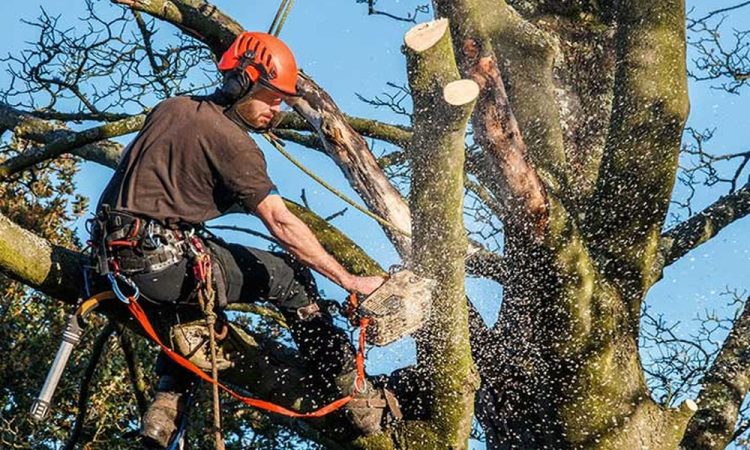
A tree comes down on the Gold Coast, and the first thing neighbours say is that it looked completely fine. No dead limbs. No lean. Nothing to suggest it was about to fail. What they did not see – what nobody sees without climbing into it – is the cavity that had been hollowing out that branch for years. Arborists get called after events like this regularly, and the finding is almost always the same. The failure was invisible from the ground and obvious up close. That gap between what a tree looks like and what it actually is doing structurally is where most serious tree problems live. It is also precisely what a professional Gold Coast tree service is trained to find before a storm does.
The V Shape Is a Warning
Two stems growing upward from the same fork look like a healthy, full canopy. They are often the most dangerous configuration in the garden. When stems compete from the same origin point, the junction between them develops compressed bark rather than a wood-to-wood connection. Bark cannot bond to bark the way wood bonds to wood. The joint looks solid. Under wind load, it separates cleanly, suddenly, and with no prior warning. The tell is the shape. A wide, rounded U where two stems meet is a strong union. A tight V with visible bark pressed into the crease is a splitting point. Fast-growing subtropical trees – the figs, poincianas, and brush boxes that fill Gold Coast gardens – develop these unions regularly, and they go unnoticed until the storm finds them.
Where You Cut Decides What Happens Next
The branch collar is the slightly raised ring of tissue where a branch meets the trunk. It looks like a small swelling at the base of the branch, and most people have never given it a second thought. It contains the specialised cells that seal over a pruning wound. Cut just outside it, and the tree walls off the cut within a growing season. Cut flush to the trunk, and those cells are gone. The wound stays open. Decay fungi move in through the exposed wood surface and begin tracking inward along the grain. The trunk looks intact from the outside. Inside, the decay is advancing. Gold Coast tree service professionals make this distinction automatically. Someone without arboricultural training seldom does, and the consequences take years to surface and cannot be reversed once established.
The Bracket at the Base Is Not Decorative
Ganoderma fungus produces a shelf-like fruiting body from the base of a tree trunk. People see it, find it mildly interesting, and leave it alone. What it is actually signalling is that the root system and lower trunk have been colonised internally for a considerable period before the bracket appeared. The visible structure comes last, not first. By the time it is there to look at, the structural root plate that holds the tree upright against wind load is already substantially degraded. The tree can be standing perfectly straight with a full, healthy canopy and be essentially unanchored. That combination – a convincing appearance and a compromised structure – is one of the more dangerous conditions a mature tree can present.
Palms Cannot Heal Themselves
Palms behave differently from every other tree on a Gold Coast property, and the difference matters. Broad-leafed trees produce new wood continuously and can reinforce or repair structural weaknesses over time. Palms cannot. They have a single growing point at the crown and no mechanism for secondary growth anywhere in the trunk. Damage to that growing tip – from borer infestation, disease, or repeated hard pruning of green fronds – is permanent. The trunk that looks solid will eventually fail at that point because nothing is being produced to replace what was lost. Palms that have been regularly over-trimmed for aesthetics are often far more structurally vulnerable at the crown than they appear.
A Storm-Damaged Tree Is Not a Stable Tree
Surviving a storm is not the same as being unaffected by one. Root systems that partially lift during high winds and settle back down lose anchoring capacity even when the tree finishes upright and undamaged in appearance. Trunk cracks that open under load and close again afterwards hide internal splits that worsen under the next weather event. Leaving a tree that came through a storm looking mostly fine without having it assessed is a reasonable-sounding decision that arborists see go wrong on a fairly regular basis.
Conclusion
Most Gold Coast tree failures were predictable. Not by the homeowner walking past every morning, but by someone who knew what to look for and got close enough to look. Co-dominant stem unions, flush-cut wounds harbouring decay, Ganoderma brackets signalling structural compromise, palms weakened by over-trimming, and storm-damaged root systems that lost their hold – these are specific, identifiable conditions. A professional Gold Coast tree service does not wait for a tree to fail before it becomes relevant. It finds the conditions that lead to failure before a storm does, which is the only point in the process where the outcome can still be changed.